

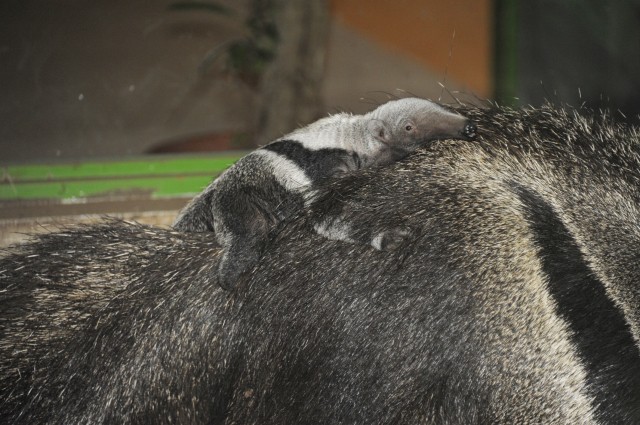


The one-week-old offspring, weighing ca. 1500 gram, is the miniature version of its 40 kg parents.
This unique-looking animal feeds primarily on ants and termites, and each part of its body has adapted to it. There are no teeth in its elongated jaw, the Giant anteater grabs the termites using its long, lightning-fast tongue and captures up to 150 insects per minute. In addition, its tongue is covered by small spikes which can penetrate into the ant passages up to 60 centimetres deep. Not just the chewing and digestive organs have adapted to this special diet, but also the speed of its metabolism and the animal’s movements. For example, its stomach does not produce hydrochloric acid; the breakdown of the food is helped by the formic acid content of the consumed ants’ bodies.
It has 5 fingers on both if its front legs. There are strong claws on the second and third fingers, which the animal uses to tear up the hard walls of the termite mounds with ease. The claws also serve as a means of protection: if the animal feels threatened, it stands on its back legs and hacks towards its assailant using its 10 cm long claws on the front legs. It also happens that is snuggles and crushes its opponent.
The Giant anteater (Myrmecophaga tridactyla) breeding couple, the 3-year-old Manka and the 2-year-old Marvin, which lives in Nyíregyháza for one year, arrived from a Danish zoo within the framework of a breeding program to enrich the collection of unique and strange looking animals in the park's Victoria house. Their food - as their daily 30,000-ants and termites cannot be provided – consists of a special anteater’s feed, as well as of ground beef, mealworms and pureed fruits.
The small anteater was born after a gestation of 180 days, and it was riding on its mother's back 20 minutes after birth. Since the offspring has the same colours as the mature animal, it "merges" into its mother's back which is an excellent camouflage in the nature against predators.
Though the offspring is now able to walk alone, it will prefer travelling on its mother’s back until it is 6 to 8 months old.
Since these mammals have the lowest body temperature (only 32.7 °C), the mother covers its offspring using her fan-like tail during sleep.
Although the young animal may sleep for 15 hours a day, the fortunate visitors can already see the mother and her offspring in the internal enclosure of the Victoria house.