

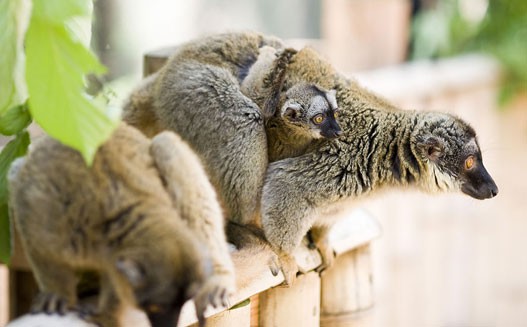


Brown lemurs were born at Sosto Zoo, in the group of so far two males and three females. The breeding group that can be found only in Nyíregyháza in Hungary is extremely successful since one offspring was born last year and two this year.
The descendants are born after a gestation period of about 120 days with the weight of 80g. At present, the infants are two and a half months old and 30 dkg. They enjoy their family’s care since each member of the family takes part in nursing. They spend together the main part of their time in the crown canopy where they sunbathe and feed. The adults are herbivorous, while the newborns are breastfed.
The lemurs pay attention to neatness, the adults clean the juveniles and also each others. Their four lower incisors and two canines compose a so-called toothcomb, respectively they have claws in the second toes of their hindlimbs; with the help of these they can remove the loosed hairs and parasites from each other.
They belong to brown lemur species but they compose a separate subspecies. Their scientific name (Lemur fulvus mayottensis) discloses many interesting pieces of information. The mayottensis expression implies that their natural habitat is the Mayotte island located 400 km far from Madagaskar. Their collective noun, the lemur originates from the Latin "lemures" word (means ghosts); the first European explorers took them for ghosts (and all the other lemurs) because they screamed loudly in the darkness of canopy, and they stared at the explorers with smoldering eyes.
The juveniles are playful, sometimes they leave the safety place of their mother’s back, and they move smarter and smarter among the branches of the trees.
In the Sosto Zoo, the family lives in a special enclosure where the visitors also can walk in and observe them from tight proximity.